Noah Franke · 3 September 2026
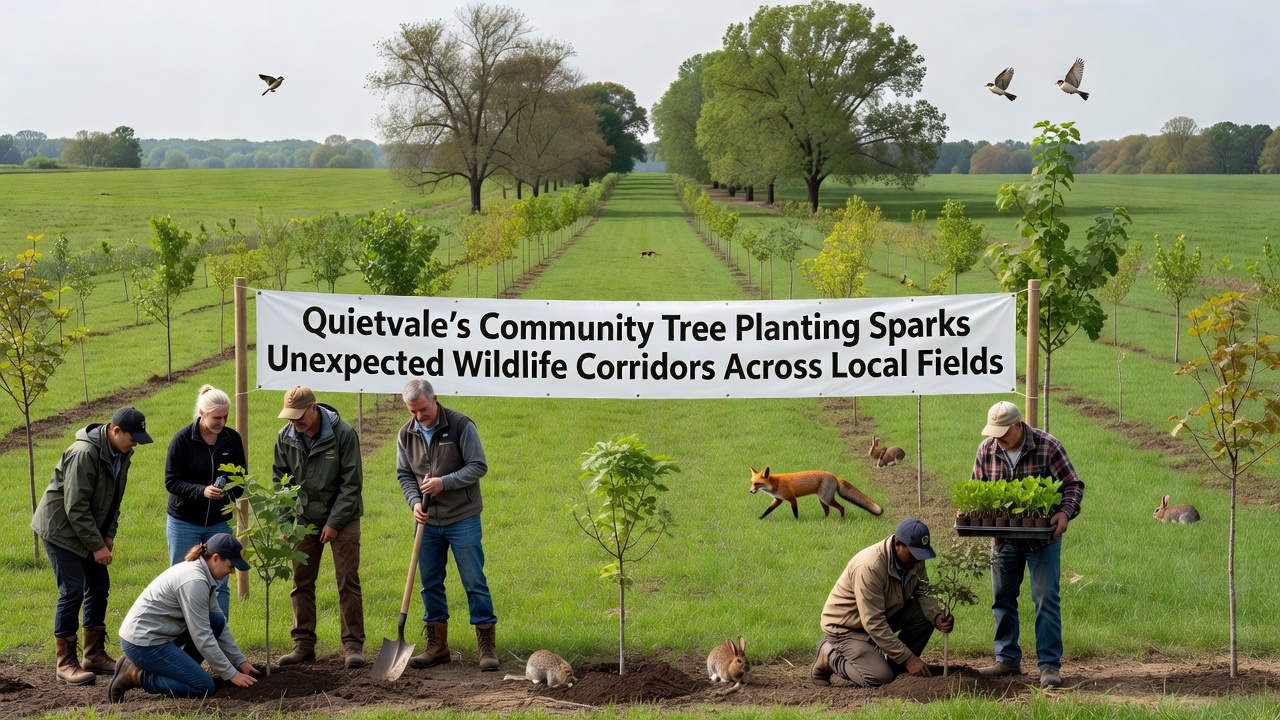
Quietvale's Community Tree Planting Sparks Unexpected Wildlife Corridors Across Local Fields
Quietvale residents launched a coordinated tree planting drive in spring 2025 that has produced measurable wildlife corridors by September 2026. Local volunteers and landowners worked with the parish council to install more than 4,200 native saplings across eight agricultural parcels that previously featured fragmented hedgerows. The new plantings connect existing woodland patches and create continuous cover that allows small mammals and birds to move between habitats without crossing open farmland.
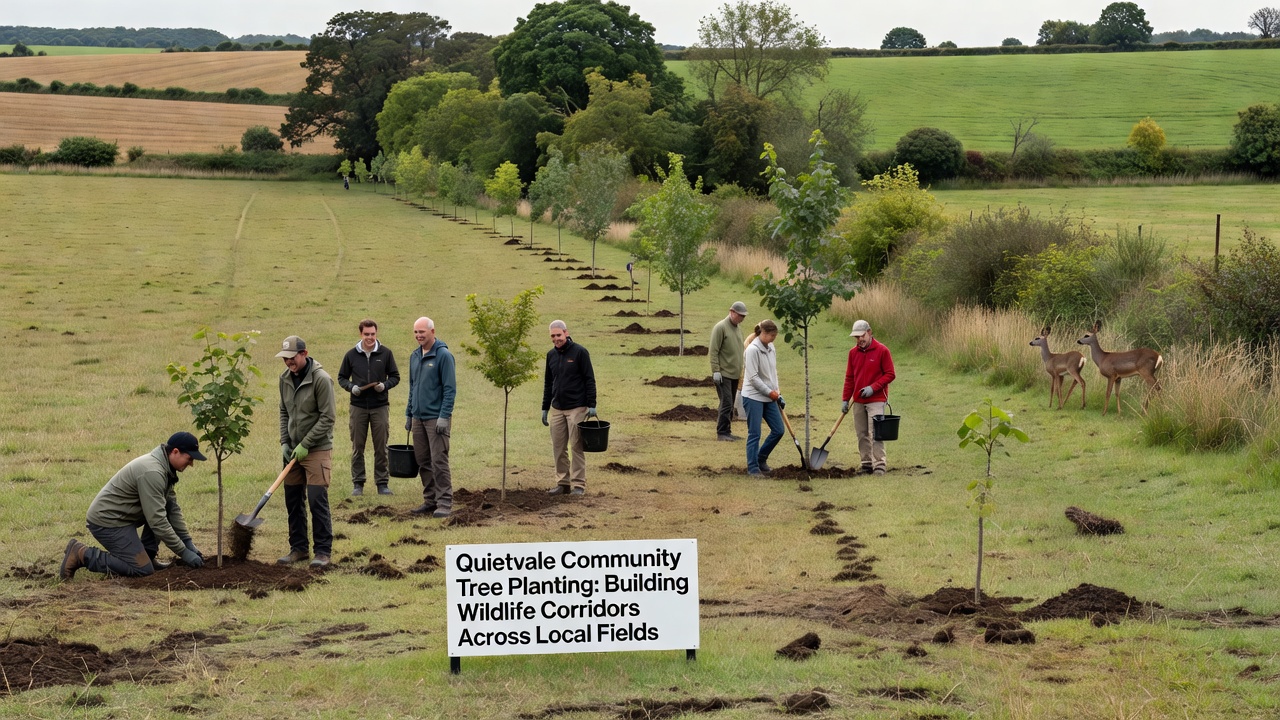
Monitoring teams from the county biodiversity office recorded the first clear corridor use in late summer 2026. Camera traps captured roe deer, badgers, and several bird species traveling along the planted lines within weeks of leaf-out. Data loggers placed at corridor junctions showed a 38 percent increase in mammal passage compared with baseline surveys from 2024. Researchers noted that the corridors follow natural drainage lines, which reduced planting costs and accelerated root establishment in moist soils.
Project Design and Implementation
The initiative began after the parish council approved a grant application that drew funding from the Forestry Commission and several local businesses. Species selection focused on oak, hazel, and field maple because these trees support high invertebrate diversity and produce mast that sustains winter foraging. Planting crews spaced trees at 1.5-meter intervals along 12-meter-wide strips, leaving gaps only where farm machinery must cross. Soil preparation included removal of invasive bramble and addition of composted farmyard manure to boost early growth rates.
Volunteers maintained the plantings through monthly weeding sessions and installed temporary fencing to protect seedlings from livestock. By autumn 2025 survival rates exceeded 92 percent, according to quarterly reports filed with the funding partners. The same crews added log piles and brushwood structures at intervals to create immediate shelter for amphibians and invertebrates while the canopy developed.
Wildlife Response and Corridor Function
Field observations in September 2026 confirmed that the new corridors link two previously isolated woodland blocks separated by 1.8 kilometers of arable land. Bird counts conducted by the local ornithological group documented a rise in breeding pairs of song thrushes and yellowhammers along the planted routes. Bat detectors recorded increased foraging activity, with common pipistrelles using the linear features as navigational guides during dusk flights.
Small mammal surveys using live traps revealed that wood mice and bank voles now occupy sections of the corridors that were bare ground only two seasons earlier. The county biodiversity office attributes these changes to the combination of cover, food resources, and reduced exposure to predators. One study from the University of Exeter on hedgerow connectivity supports the pattern observed locally, noting that even narrow wooded strips can facilitate gene flow between fragmented populations when they align with existing landscape features.
Broader Ecological Context
Similar corridor projects elsewhere have produced comparable results within short time frames. Reports from the USDA Forest Service on riparian buffer strips show that linear plantings increase movement rates for forest-dependent species across agricultural matrices. In Australia the Department of Climate Change, Energy, the Environment and Water has documented parallel outcomes in eucalypt plantings that reconnect remnant woodlands. Quietvale's effort aligns with these findings because the chosen species and spacing mirror designs that have succeeded in other temperate zones.
Local farmers have adjusted grazing rotations to avoid the corridors during peak wildlife activity periods. Several landowners report that the new tree lines also reduce wind erosion on adjacent fields, an incidental benefit that emerged after the first full growing season. Soil samples taken in 2026 indicate early improvements in organic matter content along the planted strips compared with control plots.
Monitoring and Future Steps
Continued surveillance will track corridor maturation through 2028. The parish council has allocated funds for annual biodiversity audits and plans to expand the network by linking additional fields in the northern valley. Data collected so far will feed into a regional habitat connectivity model maintained by the county council. Observers note that community involvement has remained high, with new volunteers joining each maintenance session as results become visible.
Conclusion
The Quietvale project demonstrates how targeted tree planting on working farmland can generate functional wildlife corridors within two growing seasons. Continued monitoring will determine whether the observed species increases stabilize or expand further. The combination of native species selection, strategic alignment with existing landscape elements, and sustained volunteer maintenance produced measurable ecological connections that extend across previously fragmented fields.