
Noah Franke · 15 October 2026
Quietvale Library Hosts Ongoing Discussions to Revive Overlooked Parish Narratives
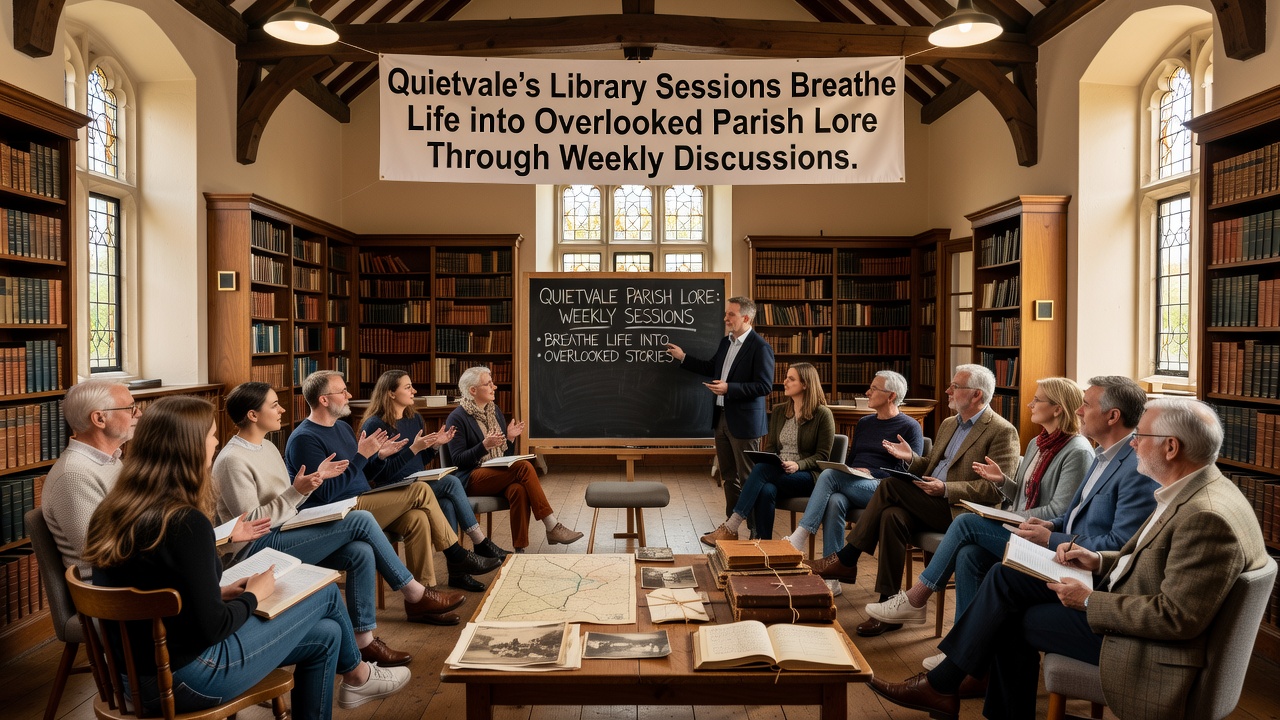
Quietvale's library has run weekly discussion sessions for several years now, and these gatherings focus on parish lore that rarely appears in standard historical records. Local residents bring documents, photographs, and oral accounts while librarians facilitate conversations that connect fragments of stories from different eras, and the format encourages participants to share details that might otherwise stay buried in attics or family memory.
Session Format and Participation Patterns
Each meeting lasts about ninety minutes and follows a loose structure where one resident presents a topic drawn from parish boundaries, old field names, or forgotten community events before the group adds context or corrections. Attendance typically ranges from fifteen to twenty-five people, with regulars including long-term residents and newcomers who moved to the area within the last decade, and this mix produces exchanges that link twentieth-century recollections with earlier nineteenth-century land-use patterns. Organizers keep a shared digital archive of notes and scanned materials so that details discussed one week can inform later sessions without requiring every participant to attend every meeting.
Topics Explored in Recent Months
Discussions have covered subjects such as the evolution of common grazing rights along the valley edges, the relocation of a small chapel that once stood near the current high street, and the seasonal migration routes used by traveling traders before motor transport became common. One session examined parish boundary markers that shifted after a nineteenth-century flood, and participants compared estate maps with surviving oral descriptions to trace how certain fields acquired their current names. These conversations often reveal connections between seemingly unrelated pieces of information, such as how a single family's land dispute influenced later road alignments still visible today.
October 2026 Schedule and Focus Areas
The library has announced that sessions in October 2026 will examine accounts of harvest customs that faded after mechanization reached the parish in the mid-twentieth century. Coordinators have invited contributions from anyone holding diaries, photographs, or recordings that describe specific practices, and they plan to pair these materials with records held at the county archive to build a more complete picture. Past patterns suggest turnout will increase during this period because harvest-related stories often prompt additional family members to attend and share details they recall from earlier generations.
Connections to Wider Historical Resources
Researchers have noted that similar community-driven projects elsewhere have produced useful additions to public records, and Quietvale's sessions follow comparable methods. According to materials available through National Archives, parish-level oral histories frequently fill gaps left by official documents that focus on property ownership rather than daily practices. A separate study coordinated by the Australian Institute of Aboriginal and Torres Strait Islander Studies has shown that regular discussion groups can surface details about land-use changes that written sources alone do not capture, and Quietvale participants have begun applying parallel verification techniques when cross-checking dates and locations mentioned during meetings.
Archive Development and Public Access
Notes and selected images from the sessions are compiled into a growing collection that the library makes available through its local history section. Staff members digitize handwritten contributions and attach them to corresponding entries in the existing parish catalogue, which allows visitors to locate related materials more easily. Several participants have donated original items after the discussions, and these additions have expanded the library's holdings beyond the printed volumes that previously formed the core of the collection. The process also creates opportunities for secondary school students to examine primary sources during local history projects, and teachers have reported that the material provides concrete examples of how parish records evolve over time.
Conclusion
Quietvale's library sessions continue to operate on a weekly basis, drawing on resident knowledge to document aspects of parish lore that standard references often overlook. The approach relies on consistent participation and careful record-keeping rather than formal academic structures, and the resulting materials remain accessible to anyone interested in the area's past. As the October 2026 schedule approaches, organizers expect the same steady level of engagement that has characterized previous cycles.